Home
» ⚽ Football
»
Arsenal vs Lille: Champions League Kickoff, Team News and Keys to the Match
Arsenal vs Lille: Champions League Kickoff, Team News and Keys to the Match
Arsenal host Lille in the UEFA Champions League on Tuesday, October 13, 2026, with the match scheduled to begin at 8:00 p.m. British Summer Time (19:00 UTC) at Emirates Stadium in London. This is Matchday 2 of the 2026/27 league phase, not a knockout game. The most useful question before kickoff is not simply who looks likelier to win, but what each team needs to do well and how viewers can recognize those signs once play begins.
Arsenal opened their European campaign with a 1-0 win away to Napoli on September 9. Lille began with a 3-2 home defeat to Real Betis on September 8, according to UEFA’s official fixture and results list. Those verified results give Arsenal three points and Lille none going into this game. They do not establish the result of tonight’s meeting.
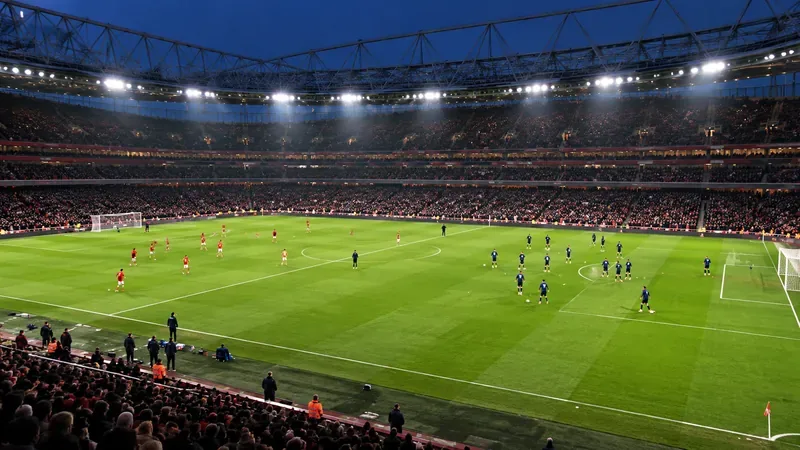
Under stadium lights, players in contrasting red and dark-blue kits warm up on the grass before a nighttime soccer match. The scene illustrates the pregame setting rather than documenting Arsenal versus Lille.
Arsenal vs Lille: Confirmed kickoff details
Competition
2026/27 UEFA Champions League, league phase, Matchday 2
Fixture
Arsenal vs Lille
Date
Tuesday, October 13, 2026
Venue
Emirates Stadium, London
Kickoff in London
8:00 p.m. BST
Kickoff in UTC
19:00 UTC
U.S. time
3:00 p.m. EDT / 12:00 p.m. PDT
Referee
Felix Zwayer (Germany)
Status of this report
Pregame information checked October 13, 2026; official starting lineups and match result not yet confirmed here
UEFA’s Matchday 2 team-news and predicted-lineup report, updated October 13, separates players listed as out from those marked doubtful. Its suggested starting elevens are predictions, not official team sheets. Treat each possible starter as provisional until the clubs or UEFA publish confirmed lineups.
Arsenal availability and projected XI
UEFA lists William Saliba as out with a back problem and Christos Tzolis as out with a hamstring issue. Piero Hincapié is marked doubtful with an ankle issue, while Martín Zubimendi is also listed as doubtful without a specified reason. None of the doubtful labels should be interpreted as a definite absence or a clearance to play.
UEFA’s projected Arsenal XI: Raya; Timber, Konsa, Gabriel, Calafiori; Ødegaard, Rice, Bruno Guimarães; Saka, Havertz, Eze.
The central defensive pairing and cover in front of it merit particular attention. A missing first-choice defender can change how aggressively a side presses, how it protects space behind the back line and who takes responsibility for progressive passes. Those are tactical questions to watch, not conclusions about an injury’s effect before the teams take the field.
Lille availability and projected XI
For Lille, UEFA lists Mbappé as suspended and Tiago Santos as out with a knee problem. Başar Önal is doubtful with a knee issue, and Perraud is doubtful for an unspecified reason. The suspension and injury listings explain why depth and substitutions may be relevant, but they do not reveal the manager’s final selection.
For Lille, the quality of their defensive spacing may matter as much as the names in attack. If their midfield stays connected to the back four, they may be better placed to absorb pressure and counter. If those lines separate, Arsenal could find more space between them. Both scenarios remain possibilities rather than verified events.
What does a good performance actually look like?
The scoreboard is decisive for competition points, but it is an incomplete assessment of a single performance. A side can create repeated promising attacks without scoring, or win through a small number of efficient moments. For this matchup, four observable measures give viewers a more useful reading than possession percentage alone.
1. Chance quality, not just shot totals
Count how often an attack ends with a controlled effort from a dangerous area, a clear final pass or a goalkeeper forced into a meaningful save. A speculative shot from distance and a close-range effort should not automatically be treated as equally good opportunities. If verified expected-goals data become available, they can add context, but any single model has limitations and should not replace watching the actual chances.
2. Control after losing the ball
Arsenal can have long spells of possession and still be vulnerable if Lille attack open lanes immediately after a turnover. Watch whether Arsenal recover quickly, force play wide or leave defenders isolated against runners. For Lille, an organized recovery into defensive shape can be a positive sign even during long periods without the ball.
3. Progression into dangerous areas
Moving the ball across midfield is useful only if it helps create threatening positions. Notice whether Arsenal can combine through the middle or reach wide areas with enough support to deliver purposeful final balls. Equally, watch whether Lille can move from a regain into Arsenal’s half without simply returning possession. Repeated entries into useful spaces are a stronger signal than territory that never becomes a chance.
4. Set pieces and defensive concentration
Corners, free kicks and second balls can decide a close contest. Track not only the initial delivery but also who reaches the loose ball afterward. One error does not necessarily define an entire performance; repeated unmarked runners or unchallenged second balls suggest a more persistent issue. This distinction matters when evaluating either defense.
The numbers behind the matchup, and their limits
UEFA’s official Matchday 2 statistical preview notes that Arsenal have won 13 consecutive league-phase matches, have recorded five clean sheets in their previous seven Champions League games, and have scored at least three goals in five of their last six home league-phase games. It also reports that Lille have lost their last eight away matches against English opponents.
Those records describe different collections of past games. They do not guarantee another Arsenal clean sheet, a particular score, or a Lille defeat. Opposition, team selection, game state and the timing of goals all influence the present matchup. A streak is most useful as background for questions about consistency, not as a substitute for assessing tonight’s play.
There are also personal connections to the fixture: Arsenal defender Gabriel previously played for Lille, while UEFA notes that Viktor Gyökeres made his Champions League debut against the French club for Sporting CP in September 2024. Such details add context without indicating how either player will perform here.
How to judge whether the match is going to plan
Moment
What to check
When the initial reading should change
First 15 minutes
Pressing height, chance locations, spacing when possession changes
An early goal or a tactical surprise alters the risks each side is willing to take
Halftime
Repeated patterns rather than one isolated chance; whether attacks are reaching the penalty area
A formation change or a player struggling physically makes first-half trends less predictive
Final 30 minutes
Substitutions, fatigue, defending of set pieces, quality of transitions
A red card, major injury or scoreline change can make earlier possession data misleading
Reassess the performance when an unusual event dominates the outcome
For Arsenal, a favorable outcome would be three points supported by sustained chance creation and controlled defensive transitions. For Lille, a strong display could include disciplined defending, an effective outlet on the break and clear chances, even if the result is unfavorable. The match result still counts: process indicators explain performance but do not award points.
Why one result matters in the Champions League league phase
The competition now places 36 teams in one league ranking. Under Article 17 of UEFA’s 2026/27 Champions League regulations, each club faces eight different opponents, with four home fixtures and four away fixtures. A win earns three ranking points, a draw one and a defeat none.
After all eight matches, places one through eight advance directly to the round of 16. Teams finishing ninth through 24th enter the knockout phase play-offs; those finishing 25th through 36th are eliminated. That makes every point valuable without turning an October game into a final verdict on qualification. If clubs end the league phase level on points, UEFA’s Article 18 tiebreaking rules begin with goal difference, then goals scored and further specified criteria.
Because Arsenal already have three points from Napoli and Lille have zero from Real Betis, the immediate stakes are asymmetric. Arsenal can reinforce a positive start; Lille can recover ground. Yet there are six league-phase matches after tonight, so neither club’s full path should be reduced to a single result.
What comes next for Arsenal and Lille?
UEFA’s schedule lists Arsenal away to Bayern München on Wednesday, October 21, and Lille at home to Galatasaray on the same date. Those fixtures offer a near-term test of whether the trends seen here were opponent-specific or reflect something more durable. Another game can confirm a pattern or expose its limits, but even two matches remain a small sample.
Fans should use UEFA’s Arsenal–Lille match center for official lineups, live match updates and the final score once published. Pregame predictions must not be relabeled as confirmed selections, and a final result should not be filled in before an authoritative source posts it. This article is a pre-kickoff preview based on information checked October 13, 2026.
Bottom line
Arsenal arrive with a winning start and encouraging historical Champions League numbers; Lille arrive needing a response and facing documented availability concerns. The fixture is set for 8:00 p.m. London time at Emirates Stadium, with Felix Zwayer appointed to referee. What viewers should look for is simpler than a bold score prediction: good chances, a reliable defensive structure, purposeful transitions and the capacity to adjust when the game changes. Those signs offer a fairer view of performance, while the official final score determines the points.