How to Check Real-Time Server Latency in the PUBG HUD

Enable PUBG’s network statistics HUD to monitor ping and packet loss in a match. See where to find it, what the numbers mean, and what they cannot diagnose.
League of Legends matchmaking can feel brutally unfair when a Silver player appears in a Platinum lobby, an autofilled jungler struggles against a specialist, or three matches in a row end in one-sided losses. But an uneven scoreboard does not automatically mean the matchmaker deliberately stacked the teams. Riot primarily tries to match players using hidden skill ratings, while visible ranks, role assignments, parties, and the reality of a snowball-heavy game make fairness hard to judge from the loading screen.
You cannot reset the matchmaking algorithm or force better teammates. You can understand what is happening, recognize when a match is genuinely unusual, and improve the decisions that affect your long-term ranked results.
MMR (matchmaking rating) is an internal estimate of skill used for matchmaking. Your visible rank and LP (League Points) describe your ranked progression, but they are not identical to MMR. Two players with different badges can be closer in matchmaking rating than their displayed ranks suggest. Riot's 2026 Ranked update specifically addressed this confusion by introducing a Climb Indicator for cases where displayed rank is behind the player's current MMR.
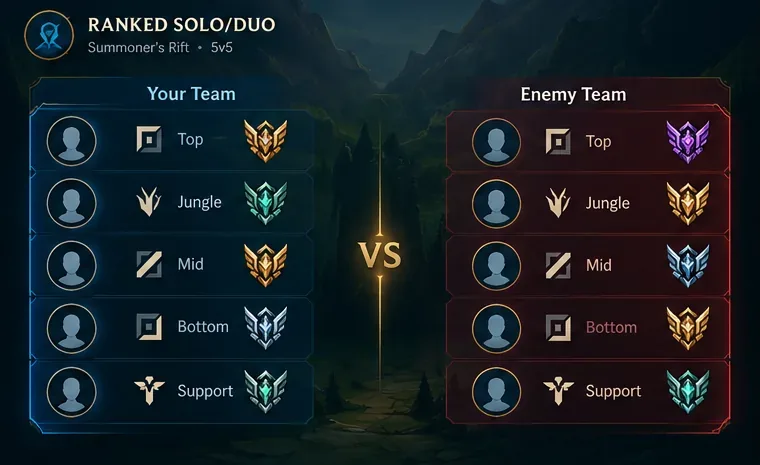
Matchmaking also has to account for which queue you're in and which positions players can fill. Solo/Duo and Flex are not interchangeable measures of skill. Riot announced changes to bring Flex matchmaking closer to Solo/Duo ratings, without allowing Flex to raise a player's Solo/Duo rating. See Riot's Ranked 2026 developer explanation.
Importantly, a matchmaker can estimate pregame balance without predicting exactly how the match will play out. Early deaths, champion scaling, objective control, communication, and a single fight around Baron can rapidly turn a close matchup into a stomp.
A player who has played relatively few ranked games may display a lower badge than their matchmaking level. The reverse can also happen while displayed progression adjusts. This is why treating every apparent rank gap as proof of a broken lobby is misleading. LP gains and losses may offer context about rank progression, but they are not a public readout of exact MMR.
Someone who performs well on a comfort champion may be much less effective in an unfamiliar jungle or support matchup. Riot has worked to reduce this disadvantage rather than remove autofill entirely, because popular-role demand affects queue times. In Patch 26.7 (March 31, 2026), Riot confirmed that improved autofill and secondary-role matching had been enabled across all regions, including attempts to match an autofilled jungler against another autofilled jungler. Riot reported better lane matchups, not a guarantee that every lane will be perfectly mirrored.
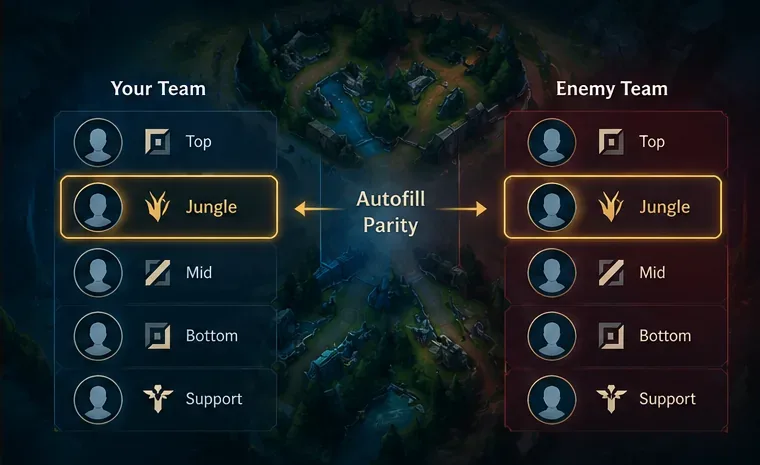
Source: official Patch 26.7 notes.
A legitimately stronger player on a new or lower-ranked account can outplay the rest of a lobby while the system estimates their skill. Account sharing, boosting, and intentionally manipulated ranks are separate integrity problems. Riot has published enforcement rules for certain forms of smurfing and ranked manipulation, but it is inaccurate to assume that every surprising performance proves someone is a smurf—or that a permanent, universal “smurf queue” is operating in the way players often describe.
Riot's account penalties and enforcement FAQ explains that major, unusual MMR changes can inform boosting detection. If you see credible evidence of account sharing, intentional feeding, or other rule violations, report the specific behavior through the game rather than accusing someone based solely on their KDA.
A matchmaker must balance match quality with getting enough players into games. At unusual hours or at the very top of the ladder, fewer suitable players may be available; Riot has previously described how repeated dodges can worsen queue times and match quality. Premade coordination can also change how a match feels, although Solo/Duo and Flex should not be treated as the same queue. Riot has historically implemented premade-parity measures, but there is no reliable basis here for claiming a fixed extra win-rate percentage for duos.
Loss streaks are painful, and memory naturally prioritizes the AFK, the 0/8 lane, or the opponent who took over a game. A streak is not evidence that Riot has targeted an account for forced losses. Also, a balanced match on paper can spiral through objective snowballing or team composition. Separate your experience of a bad game from a claim about how the system intentionally assigned it.
Compare Solo/Duo with Solo/Duo, not a player's Flex badge or highest historical rank. Watch for Riot's Climb Indicator where available, and avoid treating third-party “exact MMR” numbers as official. Riot does not publish a live, exact MMR value for your account in the client. Ask a narrower question: Was this a repeated mismatch within the same queue, or just one unexpected badge?
Choose a realistic secondary role and learn one straightforward champion for it. If you are autofilled, prioritize fundamentals you can execute consistently: safe early pathing, useful vision, objective timing, and clear pings. Do not sabotage the draft to force a dodge. Riot's 2026 system also introduced Aegis of Valor, which offers LP protection or extra LP under stated performance and eligibility conditions in qualifying autofill or priority-role games; read the active client notice before assuming a benefit applies.
Riot also changed dodging so it no longer clears autofill status, and announced stricter consequences at Master and above. Dodging every uncomfortable composition is therefore not a dependable solution. The underlying rules are documented in Riot’s Ranked 2026 update.
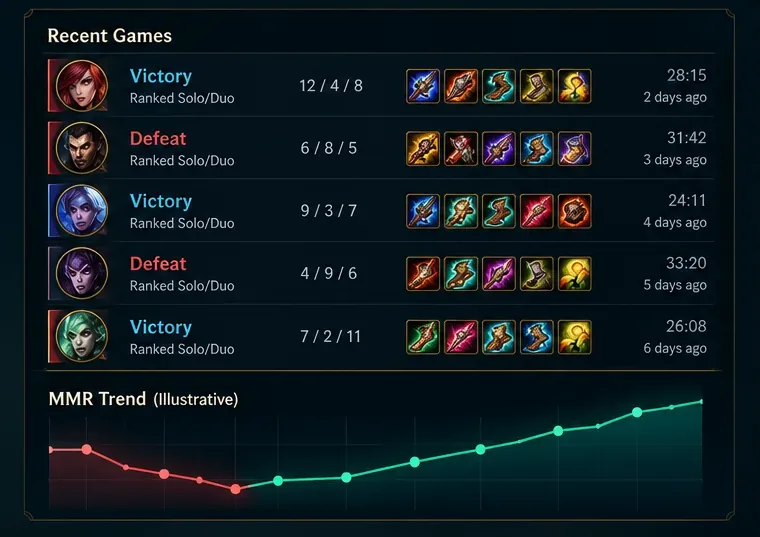
Instead of diagnosing matchmaking from your last three defeats, look at your last 15–20 ranked games in the same queue. This is a self-review sample, not a scientific test of Riot's algorithm. Record whether you played your primary position, what decided the early game, the first major objective you contested, and the biggest avoidable mistake. A review can expose repeatable decisions even when teammates vary.
| What you notice | More useful response |
|---|---|
| Many losses in an unfamiliar role | Practice one backup champion and review early decisions. |
| Strong lane, repeated throws at objectives | Review recalls, vision, and Baron or dragon setup. |
| Large visible rank gaps | Check queue type and remember that MMR can differ from displayed rank. |
| Repeated obvious disruption | Use Riot's report tools with behavior-specific details. |
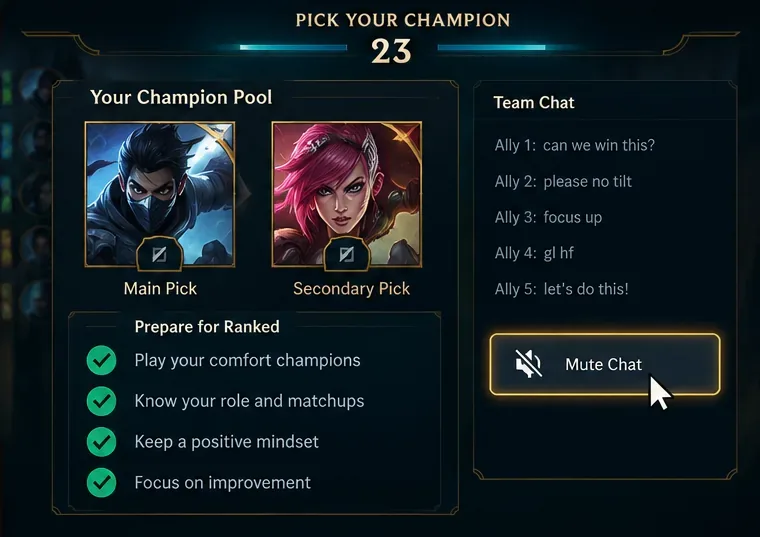
Stick to a small pool of champions you understand, including one backup for bans and unfavorable matchups. Use pings for neutral communication and mute abusive chat if it pulls attention away from decisions. Play when you are alert rather than forcing one more match after frustration takes over. A short break is not an MMR trick; it simply helps you avoid turning one bad result into several rushed games.
The 2026 changes were substantial but did not erase variance. Riot described role-based autofill matching, better alignment between Flex and Solo/Duo skill estimates, and a Climb Indicator in its December 1, 2025 Ranked 2026 announcement. The positional matchmaking improvement was confirmed globally in Patch 26.7. Riot also acknowledged genuine problems in the upper ranked ladder: its April 21, 2026 Apex-tier ranked reset explanation describes configuration errors and unstable LP gains affecting some high-ranked regions. This is stronger evidence than either claiming the system is always perfect or that every ordinary loss is rigged.
For severe in-game disruption, Patch 26.10 also documented a termination-vote system and LP/MMR loss protection in certain confirmed disruption cases. That is conditional enforcement, not general compensation for losing to a stronger opponent.
Your rank badge is not your full matchmaking rating. The opponent's MMR, your MMR, and each player's progression can differ from what their current badges imply. A single match cannot reveal the precise reason for a pairing.
There is no verified basis for saying Riot schedules guaranteed losses to punish a winning account. Higher-rated opposition or normal game variance may make later matches harder, but those are not evidence of intentional punishment.
Playing with a compatible partner can improve coordination, but it does not guarantee easier opponents or a higher win rate. Respect your queue's current duo eligibility rules and avoid boosting or rank manipulation.
No reliable public evidence supports a fresh account as a universal fix. It resets your displayed progression and can introduce new calibration uncertainty. Focus on improving your existing account and follow Riot's rules on rank manipulation.
Bottom line: League of Legends matchmaking can produce frustrating games, and Riot has acknowledged real shortcomings while changing its systems. Understand the gap between MMR and LP, plan for autofill, review more than one defeat, and spend your effort on choices that are under your control. That's a more dependable approach than trying to game a hidden rating.
Enable PUBG’s network statistics HUD to monitor ping and packet loss in a match. See where to find it, what the numbers mean, and what they cannot diagnose.
Learn how to import VALORANT crosshair codes, compare presets with manual settings and spectator copy, and fix common import issues.
Choose Dota 2 minimap size, hero icons, team colors, and background settings by readability, fewer misclicks, and clear results on your own display.
Fix Fortnite texture pop-in on PC with official steps for GPU drivers, file verification, DirectX 12, high-resolution textures, VRAM, SSDs, and stutter.
Learn what Heroes of the Storm minimap size and position options are verified, improve readability, and choose camera-click controls that suit you.
Set Super Smash Bros. Ultimate Quickplay to prefer hazards-off stages. Follow the Preferred Rules menu steps and learn why matchmaking may not always honor them.
Enable Server Latency and Packet Loss in Warzone to monitor connection quality, read the overlay, and use recurring spikes to guide troubleshooting.
Learn how to carry from mid lane in League of Legends by setting up waves, choosing safe roam windows, reading side lanes, and converting pressure into objectives.
Fix Minecraft Evoker spell problems with a safe vanilla test, version checks, log review, and a step-by-step way to isolate mod or datapack conflicts.
Fix PUBG stuck on Initializing on Steam with a focused checklist for PC service notices, launch options, game files, downloads, and connection issues.








